
Loading...
Please wait while we prepare your content.
Please wait while we prepare your content.
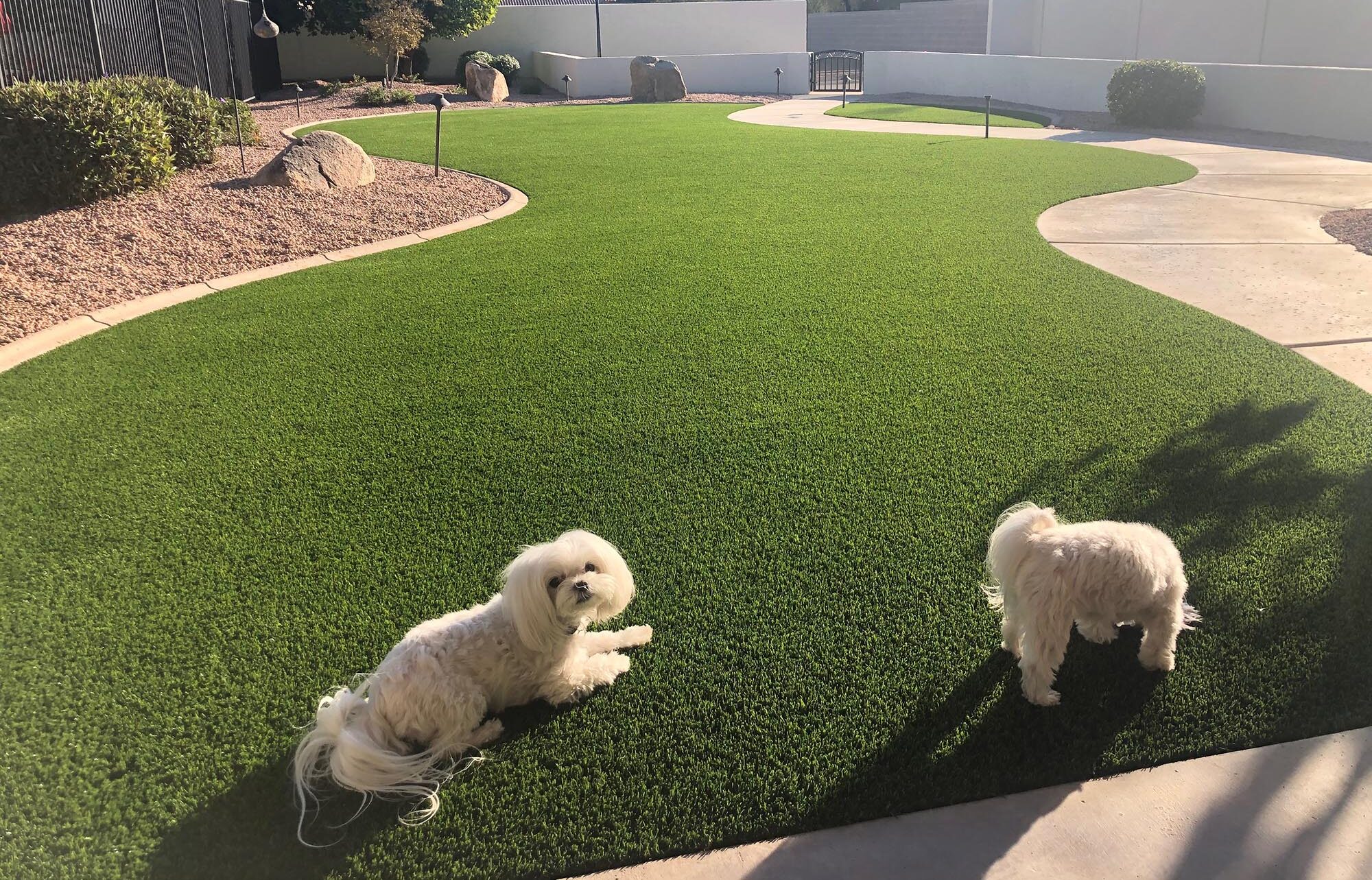
Pet-friendly artificial turf installation designed for the way Denton dog owners actually use their yards. Superior drainage, antimicrobial infill, and a surface that stays looking like a lawn — not a dog run.
Denton has dogs. A lot of them. The college-town demographic, the active outdoor culture, the walkable neighborhoods around the Square and North Lakes Park — all of it adds up to a city where pets are a significant part of daily life and backyards take real punishment from them. Natural grass in a Denton backyard with one or two active dogs is a losing proposition, especially given the clay soil, the summer drought cycle, and the fact that Bermuda grass doesn't exactly bounce back fast from urine damage and digging. The result for most dog owners is a yard that spends most of the year looking wrecked — brown patches where dogs relieve themselves, bare dirt areas where they run the same loops, muddy mess zones after any significant rain, and a constant cycle of reseeding and hoping.
Pet-friendly artificial turf breaks that cycle completely. The system is designed around exactly how dogs use outdoor space — continuous movement, high-use zones, repeated urination in specific spots — and it handles all of it without the degradation cycle that natural grass can't avoid. What you end up with is a yard that looks like a lawn, functions as a clean outdoor space for both your dogs and your family, and requires a fraction of the maintenance time of the natural alternative.
The core of a pet-friendly turf installation is drainage. Dog urine needs to drain quickly and completely rather than pooling at the surface or saturating a sand infill layer where bacteria can multiply in the Texas heat. Our pet-specific installations use drainage-optimized backing — perforated or flow-through backing systems that push liquid through rapidly rather than retaining it. Combined with a properly graded aggregate base and adequate drainage slope, urine and rinse water clear the system efficiently rather than sitting at the surface or creating wet zones in the base.
Infill selection is the other major variable. Standard silica sand infill works in many residential applications, but for high-dog-traffic areas in a Denton summer — where surface temperatures can be intense and bacterial activity in retained organic matter accelerates — antimicrobial infill is a meaningful upgrade. We use infill products with antimicrobial properties that inhibit the bacterial growth responsible for odor development. Zeolite-based infill, which has natural ammonia-absorbing properties, is another option we recommend for households with multiple dogs or heavy use areas. These aren't upsells for their own sake — in a Texas summer with heavy pet traffic, the difference between standard and antimicrobial infill is noticeable.
The turf product itself matters for pet applications. We select pet-specific products with reinforced backing that resist digging damage, with monofilament or combination fiber construction that doesn't trap debris and cleans easily. Face weight and fiber density are chosen to handle high-traffic use patterns while remaining soft enough for dogs to lie and play on comfortably. We don't use the same product for a dog yard that we'd use for a formal front lawn — the specifications are different for a reason.
Pet odor in artificial turf is, honestly, a climate-sensitive problem. In moderate climates with cool summers, a standard turf installation with decent drainage performs adequately even with heavy pet use. In Denton, where ambient temperatures stay above 90°F for months and surface temperatures on synthetic turf in direct sun can run considerably higher, the chemistry of bacterial activity in any retained organic matter runs faster. What's manageable in Seattle is not the same calculation in Denton in July.
We're straightforward about this because it shapes how we recommend and specify pet-turf installations here. Proper drainage infrastructure is non-negotiable — not optional or a premium add-on. Antimicrobial infill is our standard recommendation for dog-primary yards rather than an upgrade conversation. Product selection with low fiber-retention characteristics reduces the amount of organic material that stays on the surface between cleanings. And routine rinsing — which homeowners can handle with a standard garden hose — is part of the maintenance rhythm for any pet-use area in a Texas climate.
The good news is that when the system is properly specified, it performs dramatically better than natural grass in any weather. No mud. No urine-kill patches. No post-rain mess that tracks into the house for the next three days. The yard stays usable immediately after rain events, stays clean between those events, and stays visually consistent year-round in a way that no natural grass dog yard in Denton County can match.
Many pet owners in Denton opt for a dedicated pet area or dog run installation rather than converting the full backyard. This approach makes excellent sense for households where the dogs primarily use a defined zone — often a side yard, a fenced run parallel to the house, or a designated back corner — while the rest of the yard remains in a different use. We design these dedicated runs with the same drainage and infill standards as full-yard installations, sized and configured to the actual space and the number and size of dogs using it.
Dog run installations in the Robson Ranch community have been popular among residents who want clean, manageable pet areas that meet the community's aesthetic standards without the maintenance demand of natural grass. In the ranch-edge communities of Sanger and Krum where yards are larger, targeted pet-area installations on the high-use zones give homeowners the best of both worlds — controlled pet space with proper drainage, natural ground cover elsewhere.
Pet-friendly turf is designed primarily around dogs but performs equally well for cats, rabbits, and other small animals that use outdoor enclosures. Catio enclosures, rabbit runs, and outdoor small-animal habitats all benefit from the easy-clean, drainage-ready characteristics of pet-specific turf. The antimicrobial infill properties are particularly relevant in enclosed small-animal areas where air circulation is limited and odor management matters more.
We install pet-friendly turf for dog owners throughout Denton — North Lakes Park neighborhoods, Pecan Creek, Westwood Park, Mockingbird Pointe, and the Old Town district — as well as across the county in Corinth, Argyle, Sanger, Krum, Flower Mound's northern sections, Highland Village, Lake Dallas, and Hickory Creek. Wherever you are in Denton County, if your dogs are destroying your yard, we've worked in your neighborhood.
Contact Artificial Turf of Denton to discuss your pet-specific situation. We'll ask about your dogs — how many, what size, what their typical use patterns are, whether you have specific problem zones — and use that to recommend a system that actually fits the way your yard gets used. No generic presentations. A consultation that starts with your actual dogs.
Properly specified and maintained, no. The key variables are drainage-optimized backing that clears liquid quickly, antimicrobial infill that inhibits bacterial growth, and a routine of occasional rinsing. In Denton's climate, we recommend antimicrobial infill as standard rather than optional for dog-primary yards.
Pet-specific products have reinforced backing designed to resist digging damage. No turf is completely dig-proof against a determined large dog, but the backing construction on pet-grade products handles normal and moderate digging behaviors without damage.
It depends on your dogs' use patterns. If they primarily use a defined zone, a targeted run installation makes economic sense and performs exactly the same. For yards where dogs roam the entire space, a full conversion often makes more sense. We discuss this during the consultation around your specific situation.
For single-dog households, periodic rinsing — roughly once a week depending on use intensity — keeps the area fresh. Multiple-dog or high-traffic areas benefit from more frequent rinsing. In Denton's summer heat, rinsing more frequently during the hottest months helps maintain surface freshness.
Yes. We use pet-safe materials throughout. The antimicrobial infill we recommend for pet areas is non-toxic and specifically formulated for pet contact. Surface temperature in direct afternoon sun in summer is a real consideration — for households where dogs use the yard during the hottest part of summer afternoons, we discuss shade, infill options, and use patterns during the consultation.
Get started with pet friendly artificial turf installation. Contact our Denton team for a free consultation.