
Loading...
Please wait while we prepare your content.
Please wait while we prepare your content.
Residential artificial turf installation across Denton County. Built for Denton clay soils, North Texas heat, and homes where the yard actually gets used — by families, musicians, dog owners, and everyone in between.
Denton neighborhoods run the full spectrum from the historic bungalows and craftsman homes tucked behind the Courthouse-on-the-Square to the newer subdivisions spreading out along Mayhill Road, the Robson Ranch active-adult community in the city's southwest, and the acreage properties edging toward Sanger and Krum to the north. What they all share is the same basic problem: natural grass in Denton County is a fight. The clay-heavy soil profile across much of the county drains poorly in wet springs and cracks in summer heat. Water restrictions complicate irrigation schedules. Bermuda grass browns out by late August. Warm-season grass goes dormant by November and doesn't come back until April. Maintaining anything approaching a year-round green lawn in Denton with natural grass takes work, water, and money that most homeowners would rather apply somewhere else.
Artificial turf removes most of that fight. Once installed, the lawn stays green regardless of whether you watered it last Tuesday or it hasn't rained in six weeks. It doesn't go dormant in December. It doesn't develop yellow patches from pet use or high-traffic areas. It doesn't need mowing the weekend before you were planning to spend Saturday at Andy's Bar catching a show. For Denton residents who moved here partly because of a lifestyle that values time — time for music, for the Square, for university life, for family — the math on reclaimed weekend hours is real.
Most artificial turf marketing talks generically about "Texas heat" and "saving water." Those things are true but incomplete for Denton County specifically. The soil here is a different animal than what you find in the sandy loam of the suburbs south of DFW. Denton County clay is expansive — it swells with moisture and contracts in drought, and that movement creates real problems for turf installations that weren't designed for it. Edge lifting, seam gaps, and uneven sub-surfaces are common failure modes when installers use a one-size-fits-all approach designed for more stable soils.
Our residential installations account for this from the ground up. Base preparation in Denton means working with what the clay profile actually does — establishing the right aggregate depth, compaction level, and drainage grade that allows seasonal moisture movement without transferring that movement to the turf surface above. Properties in Robson Ranch's age-restricted community, the Pecan Creek area, North Lakes Park neighborhoods, Westwood Park, and the Mockingbird Pointe corridor all sit on soil that rewards proper base preparation and punishes shortcuts. We've installed across all of these areas and we spec accordingly.
Heat management matters for residential turf in Denton summers. Turf surface temperature under direct afternoon sun in August gets hot — that's a real characteristic, not a surprise. Product selection, infill choice, and thoughtful orientation of the installation can moderate this. We discuss heat performance honestly during the consultation so you're making a fully informed decision about product and use-case fit rather than finding out about it after the fact.
Certain Denton property profiles benefit most from residential artificial turf. Front yards on corner lots and high-visibility properties where curb appeal matters consistently are a natural fit — the lawn stays presentation-ready without constant upkeep. Backyards in family households where kids and pets are the primary users see a dramatic reduction in the mud-tracking, bare-patch, and yellow-spot cycle that natural grass in heavy-use areas can't escape. Homes with dogs especially benefit: urine doesn't kill artificial turf, cleanup is simpler, and the lawn doesn't develop the scarred, overused look that high-dog-traffic natural grass inevitably produces.
Properties in the ranch-edge transition communities north of Denton — Sanger, Krum, Pilot Point, and the ag-fringe areas along Hwy 77 — often have larger lots where full natural grass maintenance is genuinely time-consuming. Partial-conversion installations on high-traffic areas like side yards, dog runs, and backyard entertainment zones give those homeowners the low-maintenance benefit where it matters most without committing to a full-property install.
Townhomes and zero-lot-line properties near the university district and older Denton neighborhoods frequently have small, difficult-to-mow yard areas that natural grass handles poorly — shade, narrow access, or soil compaction from years of use. Artificial turf in those spaces turns a maintenance headache into a clean, finished outdoor room. Patio surrounds, side passes, and enclosed courtyard areas all work well with synthetic turf where natural grass never really had a fighting chance.
Residential artificial turf is not a single product — blade height, fiber density, color tone, and infill type all vary across applications and personal preferences. Shorter-pile products with a tighter face weight work well for formal front yards and putting green areas. Longer, fuller pile with softer fiber construction is more appropriate for family backyards and areas where kids and pets will spend time on the surface. We carry product options across this range and walk through samples and characteristics with every homeowner before making recommendations.
Infill selection is another real variable for residential applications. Standard silica sand infill works well across most residential installs. For pet-specific areas where odor control is a priority, antimicrobial or zeolite-based infill options perform noticeably better in the Denton heat. Cooling infill products can help moderate surface temperature during peak summer — relevant for homes where children or pets use the space during afternoon hours in July and August.
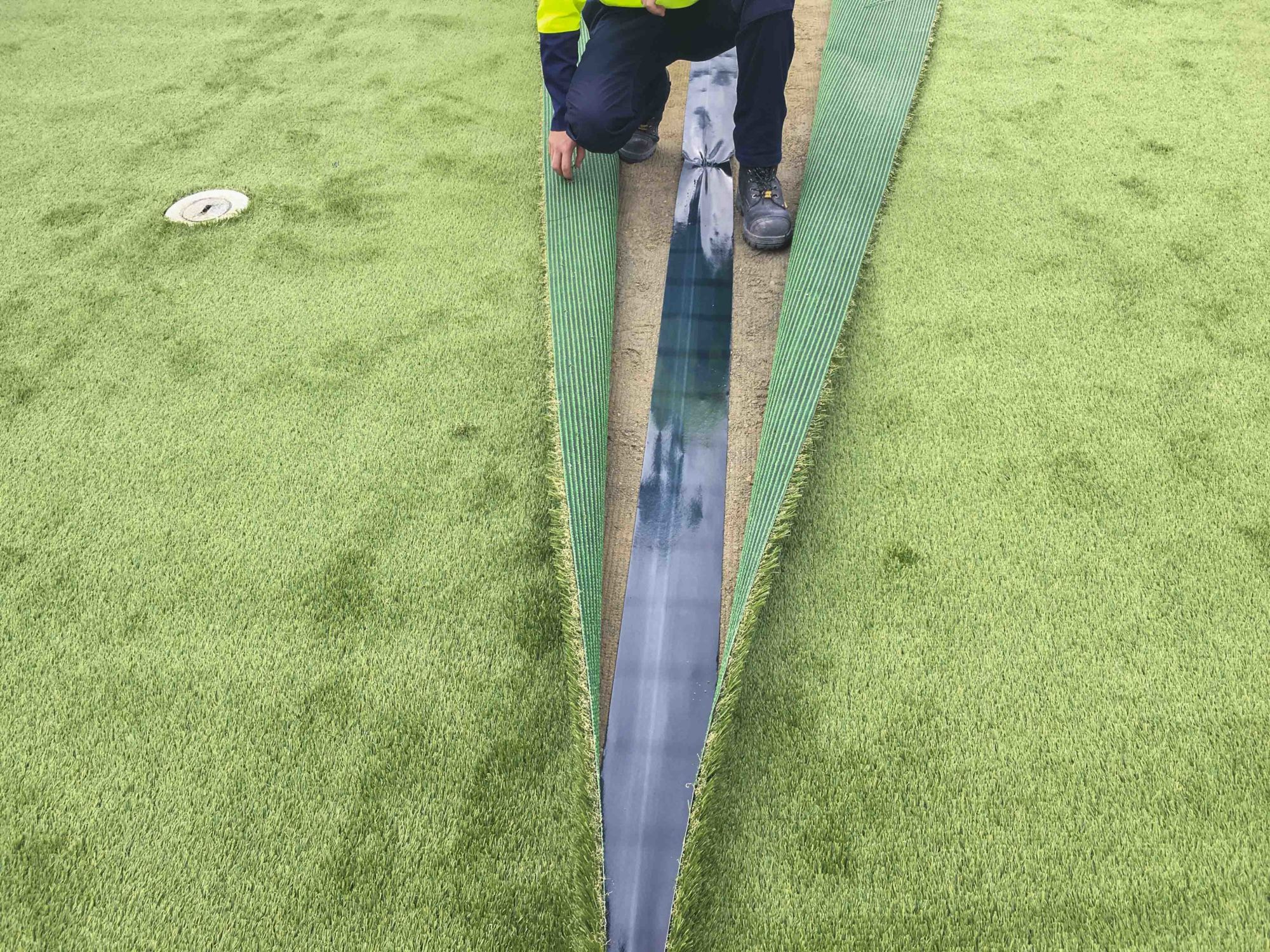
Most residential installations take one to three days depending on scope. We begin with site preparation — removing existing sod and vegetation, grading the sub-surface for drainage, and installing the aggregate base. Base work is not a step to compress or rush. In Denton County clay, base quality determines whether the installation holds its surface over years of seasonal movement. Turf is then laid, seams are positioned and bonded, edges are anchored to the perimeter, and infill is applied and power-broomed to proper distribution.
We walk the completed installation with you, explain routine care, and leave you with written post-install guidance. Routine care for residential turf is minimal — periodic brushing with a stiff broom to keep fibers upright, rinsing to clear surface dust and debris, and spot-rinsing of pet use areas as needed. Most homeowners find they spend dramatically less time on lawn maintenance after installation than they anticipated, which was the point.
We install across the full residential geography of Denton County: Denton proper including the Old Town area, North Lakes Park, Pecan Creek, Westwood Park, Mockingbird Pointe, and the Robson Ranch active-adult community. Also Corinth, Hickory Creek, Lake Dallas, Highland Village's north-edge neighborhoods, Argyle, Flower Mound's northern sections, Lewisville north of 407, and the northern communities of Sanger, Krum, Pilot Point, and Aubrey. If you're in Denton County, we serve your area.
Contact Artificial Turf of Denton to schedule a free in-home consultation. We'll walk the space, discuss your household's specific use case, review product options appropriate for your application, and provide a clear estimate. No pressure close, no generic presentation — just honest conversation about whether residential turf makes sense for your property and what the right installation would look like.
Expansive clay swells with moisture and contracts in drought. That movement can lift edges and open seams if the base isn't properly prepared for it. We spec base depth, compaction, and drainage grade around the clay behavior typical of Denton County properties rather than using a generic DFW approach.
Surface temperature under direct afternoon sun does run warm — we're honest about this. Product selection, infill type, and shade from structures or trees can all moderate it. We discuss this specifically for your property during the consultation so you're choosing the right product for your use case.
Most residential installations are completed in one to three days depending on the size of the area. Base prep is not rushed — that's where the long-term quality of the installation is determined.
Often yes, especially for shaded or compacted small yards where natural grass performs poorly anyway. Townhomes and urban lots near campus frequently have challenging conditions that artificial turf handles better than natural grass ever will.
Yes — we serve the full Denton County residential area including the ag-edge and rural communities north of the city. Larger lot properties in Sanger, Krum, Pilot Point, and Aubrey are often good candidates for partial-conversion installs on high-use zones.
Get started with residential artificial turf installation. Contact our Denton team for a free consultation.